Goat by Bruce Weinstein & Mark Scarbrough
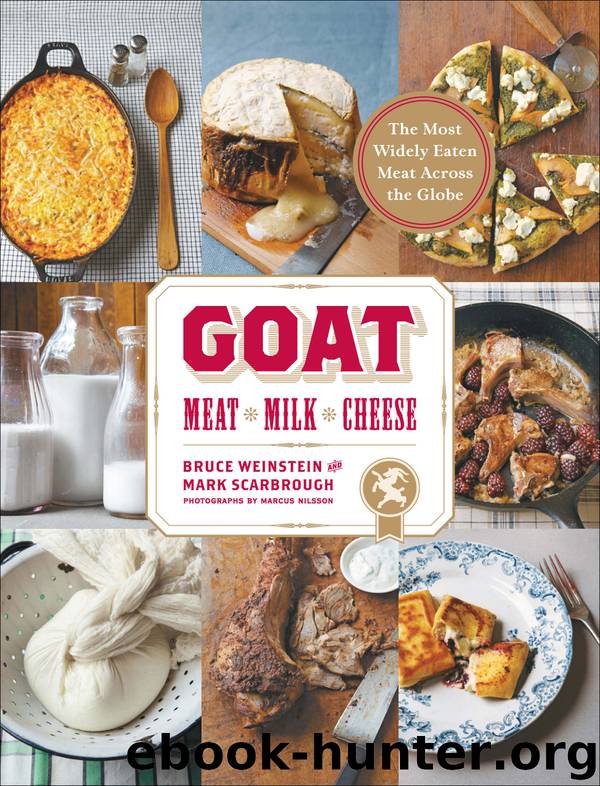
Author:Bruce Weinstein & Mark Scarbrough
Language: eng
Format: epub
Publisher: Stewart, Tabori & Chang
Published: 2011-10-06T04:00:00+00:00
BY NOW YOU CAN SEE that being a goatherd is not an easy matter. These animals are both smart and independent, like a pet dog or cat. Images dealing with a herd of those. But let’s say you were going to be a goatherd. Let’s just say. You must first decide why you want to be a goatherd. You’ve got three options:
1. Meat These days, you’re most likely going to go with the Boer goat, brought fairly recently to North America from South Africa. Although some of the Boers at 4-H shows are hulking creatures, most are small, more diminutive than the girls who stand on the milking line. Most Boers are also white with red or brown splotches, although some have splotchy red or brown coats. They’re not skittish; however, they’re also not terribly friendly. In the end, they just don’t see humans as a source of food or udder relief.
Other popular meat breeds include the Kiko from New Zealand, with its broad, don’t-mess-with-me horns; the Savanna, mostly white, with well-muscled haunches and (like a superhero gone to seed) loose skin at the neck; and the famed Myotonic goats, also called the Tennessee fainters—as if they were a bridge club prone to moral outrage. These pass out for up to ten seconds when startled.
2. Wool You’re looking for soft hair and a calm disposition. You can’t cuddle with well-muscled haunches. (Consider this relationship advice as well.) You might first consider cashmere goats and their near kin, the pashminas. Their wool is renowned, but separating the soft stuff from the coarse hairs is quite a job. So you’ll probably end up going with Angoras, small goats that came out of Turkey to the delight of the knitting and spinning set. An Angora’s hair—called mohair (a.k.a. my contact lens is killing me)—is lush and prolific: One of these babies can bring in 12 pounds (5.4 kg) of mohair a year. Although a bit athletic, an Angora will go in for quite a bit of brushing and grooming, much like the closet-case cheerleaders in your high school.
3. Milk (and thus yogurt and cheese, too) You’ll probably select from these five breeds:
Nubians, larger than Boers, bulky, almost the dairy cow of goats (in looks only, because the breed actually produces less milk than some others), with a short, glossy coat and long, dangling ears.
Oberhaslis, moderate milk producers from Switzerland with fairly big ears that stick straight out from the head like little wings; a little smaller than Nubians, with a reddish brown or black coat, but a bit aggressive (in mixed packs, an Oberhasli will most often be the goat queen).
Alpines, a smaller breed, from the French Alps, but a great dairy goat, producing a particularly fatty milk, best in cheeses and ice cream
Saanens, another breed from Switzerland, this one pure white, with ears like the Oberhaslis but an otherwise gentle, almost passive temperament; known for its high milk production and for the fact that both bucks and does have horns.
La Manchas, sturdy
Download
This site does not store any files on its server. We only index and link to content provided by other sites. Please contact the content providers to delete copyright contents if any and email us, we'll remove relevant links or contents immediately.
Better Homes and Gardens New Cookbook by Better Homes & Gardens(3600)
The Sprouting Book by Ann Wigmore(3599)
Trullo by Tim Siadatan(3435)
Super Food Family Classics by Jamie Oliver(3428)
Hedgerow by John Wright(3373)
Panini by Carlo Middione(3347)
Bread Revolution by Peter Reinhart(3150)
Sauces by James Peterson(3103)
Jam by Jam (epub)(3102)
Ottolenghi - The Cookbook by Yotam Ottolenghi(2954)
Oh She Glows Every Day by Angela Liddon(2785)
My Pantry by Alice Waters(2626)
Veg by Jamie Oliver(2504)
Hot Sauce Nation by Denver Nicks(2501)
The Culinary Herbal by Susan Belsinger(2484)
Meathooked by Marta Zaraska(2264)
The Art of Making Gelato by Morgan Morano(2260)
Wanderlust by Jeff Krasno(2258)
Basic Illustrated Edible and Medicinal Mushrooms by Jim Meuninck(2226)
